

8 Saved ChatGPT Prompts for Consistent Brand Voice
I use eight saved ChatGPT prompts to keep brand voice consistent across drafts, rewrites, and reviews. In ChatGPT’s browser interface, I can paste templates from a document or insert them with an optional desktop browser extension; extension support and saved-prompt limits depend on the tool and plan.
My choice comes down to storage and access. A document works for a shared template library, while an approved extension suits frequent browser use. Neither is required to use these prompts. ChatGPT’s native Custom Instructions handle account-wide preferences - not a library of eight separate task templates.
I keep the brand rules separate from each job’s audience, channel, and source copy. That lets me reuse the instructions without carrying old campaign details into new work.
The goal is consistent voice - not identical wording. I still check facts, protected terms, and the finished layout before publishing. Saved prompts support review; they do not replace human approval.
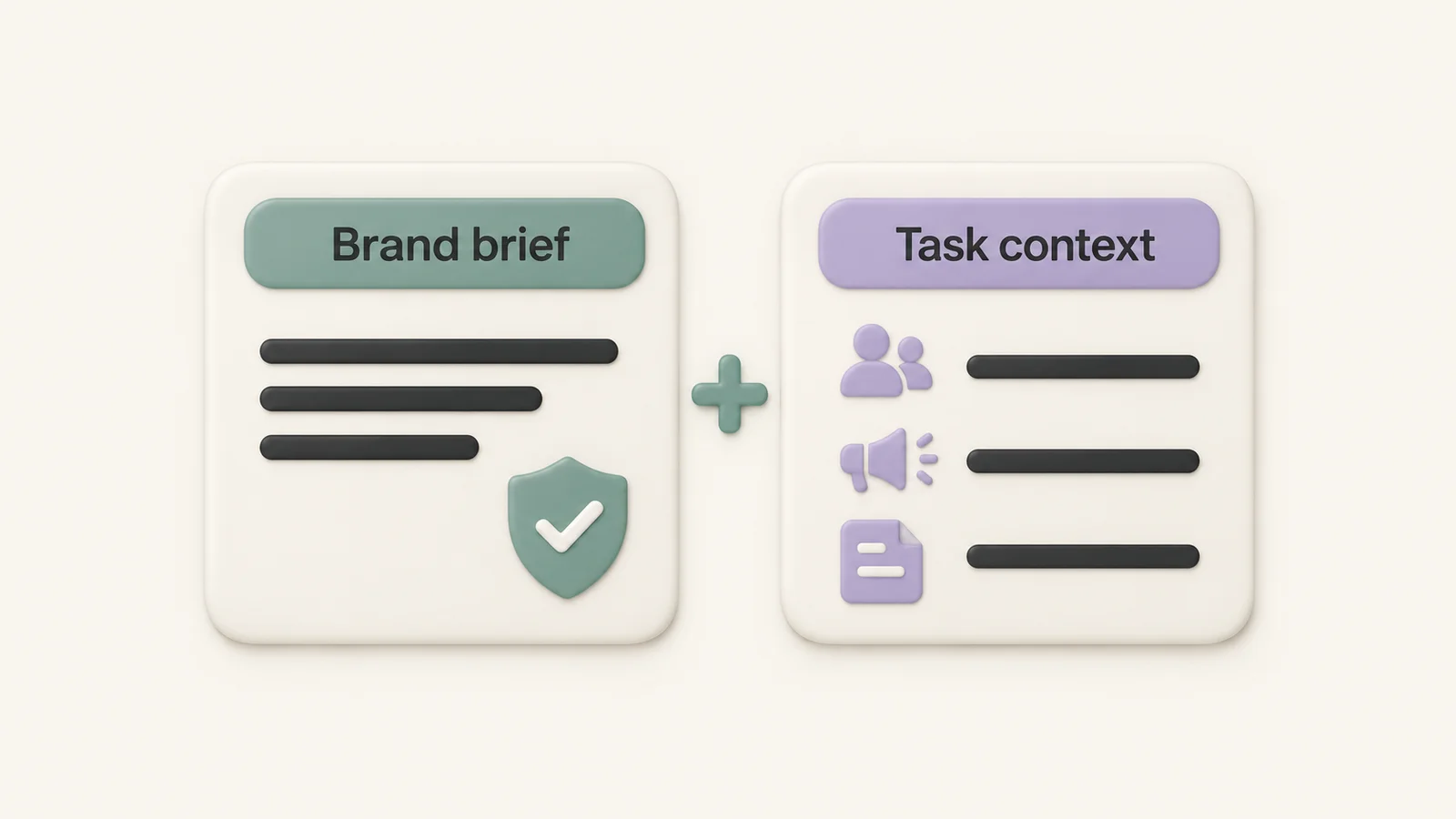
Combine stable brand rules with fresh task details each time. This is a conceptual illustration, not an interface screenshot.
Create a Reusable Brand Brief
Pair this brief with each saved prompt. Keep stable voice rules separate from task-specific inputs so campaign details don’t turn into permanent defaults. Replace every bracketed field before sending.
Set Voice Rules, Terms, and Approved Samples
Save the block below as your reusable brand context. Describe personality through writing behavior, not just adjectives. Add one or two approved samples to show the tone and rhythm you want, and tell ChatGPT not to copy their wording.
STABLE BRAND CONTEXT
Brand: [BRAND NAME]
Audience, product, and topic knowledge: [AUDIENCE]
Voice traits and writing behaviors: [VOICE RULES]
Reading level: [READING LEVEL]
Sentence-length preference: [SENTENCE-LENGTH RULE]
Approved terms: [APPROVED TERMS]
Discouraged terms and preferred replacements: [DISCOURAGED TERMS]
Protected names, capitalization, and required wording: [PROTECTED TERMS]
Formatting rules: [HEADINGS, PUNCTUATION, BULLETS, CTA STYLE]
Approved sample 1: [APPROVED SAMPLE 1]
Optional approved sample 2: [APPROVED SAMPLE 2]

Use samples as style references only; do not copy wording.
Preserve protected wording exactly.
Use only verified claims supplied with the task.
Add Task Details and Source Copy
Update the task details for each job. Include the relevant source text and verified claims. Don’t assume ChatGPT knows your latest product details, prices, dates, or performance claims.
TASK-SPECIFIC INPUTS
Channel: [CHANNEL]
Purpose: [PURPOSE]
Audience segment and situation: [CURRENT AUDIENCE CONTEXT]
Desired action: [DESIRED ACTION]
Target length: [WORD COUNT OR CHARACTER LIMIT]
Date context or deadline: [DATE AND TIME ZONE]
Required elements: [REQUIRED ELEMENTS]
Verified claims and supporting sources: [VERIFIED CLAIMS]
Source copy: [SOURCE COPY]

Do not invent facts, statistics, testimonials, or guarantees; treat source copy as editable material, not proof.
If required information is missing, ask before drafting.
Flag unsupported claims for review rather than guessing.
Set U.S. Spelling and Formatting
Use en-US spelling and U.S. formatting: color, behavior, organize; $1,250.50; October 10, 2026. Use commas for thousands, periods for decimals, and explicit time zones for deadlines.
Use U.S. customary units and Fahrenheit when appropriate. Keep source measurements unchanged unless a conversion is requested and verified.
Save this brand brief, then use Prompt 1 to draft copy in your voice.
1. Draft Copy in Your Brand Voice
Intended writing task
Use this saved prompt to write first drafts of emails, product pages, or event invitations - not to rewrite existing copy. It keeps your brand voice consistent while adjusting tone to the reader’s situation. Not every message needs the same upbeat delivery.
Paste-ready instructions
Check that the brief includes audience, purpose, channel, desired action,
length, and voice rules. If anything is missing, ask concise questions
and wait for answers.

Draft copy using the brand brief and task-specific inputs.

Keep the brand voice consistent. Adjust tone to the audience’s context,
channel, and purpose. Follow approved terminology, samples, and the
brief’s formatting rules.

Use only supplied facts and approved claims. Do not invent stats,
testimonials, quotes, capabilities, guarantees, citations, or legal
language. Preserve approved legal wording exactly.

Do not make other assumptions without explicit permission. List approved
assumptions under 'Assumptions' and mark unresolved items
[NEEDS CONFIRMATION].

Keep editorial notes separate from the draft. Return four sections:
- Draft
- Assumptions
- Brand-voice notes
- Review checkpoints
Required brand context
Fill in only the brand details missing from the reusable brief. Add the brand’s positioning and approved CTA wording. Set clear boundaries for each voice trait:
“confident, without absolute promises” is more useful than “professional.”
Output and review checkpoints
Keep editorial notes separate from copy that’s ready to publish. Check every factual statement against its approved source. Confirm that the CTA matches the actual next step, then verify length and U.S. formatting. If copy already exists and you only need a rewrite that preserves its meaning, move to Prompt 2.
2. Rewrite Copy Without Changing Its Meaning
Intended writing task
Use this when approved copy needs cleaner wording that fits the brand. This is a meaning-preserving rewrite, not a summary, expansion, fact-check, or repositioning. Keep the message intact. Change only how it’s delivered.
Paste-ready instructions
Rewrite the source copy below for clarity, flow, concision, and the supplied brand voice.

Before responding, compare the rewrite with the source. Preserve its meaning, certainty, qualifiers, intent, and audience exactly.

Do not change names, titles, product names, numbers, dates, times, prices, URLs, emails, hashtags, promo codes, quoted text, headings, required terms, CTAs, or legal/technical disclaimers. Keep qualifiers such as may, can, could, typically, approximately, and up to unchanged.

Do not add facts, benefits, promises, examples, statistics, citations, evidence, or interpretations that are not in the source. Keep all important conditions, limitations, and qualifiers. Do not strengthen or soften claims.

Use U.S. English in editable text, including U.S. spelling and conventions for punctuation, dates, numbers, currency, and customary units where relevant. Do not silently convert protected dates, prices, or measurements without explicit permission.

If the source is ambiguous, contradictory, factually unsupported, or missing necessary context, do not guess. Flag it for review. If an edit could change the meaning, leave that wording unchanged and ask for clarification.

Return:
- Revised copy
- Change log
- Flags for ambiguity, unsupported claims, risk of altered meaning, or missing information

Brand brief:
[PASTE BRIEF]

Protected elements and explicitly permitted changes:
[PASTE DETAILS]

Source copy:
[PASTE COPY]
Required brand context
Reuse the stable brand brief from Prompt 1. Add only rewrite-specific details and any approved or off-brand samples for this passage.
Keep the stable brand voice separate from situational tone. When only one passage needs work, leave the rest unchanged.
Output and review checkpoints
Compare the rewrite with the source, paying close attention to names, numbers, URLs, disclaimers, and qualifications. Make sure the change log reflects the actual edits, and resolve every review flag before publishing. Preserving a claim does not verify it, and smoother wording does not guarantee accuracy.
If the rewrite also needs a check for tone or off-brand language, move to the next saved prompt.
3. Match an Approved Voice Sample
Intended writing task
Use this when “friendly” or “professional” doesn’t give enough direction. Ask ChatGPT to treat approved copy as evidence of style, not a source of content. The aim is to carry over recognizable writing patterns - not the sample’s claims, facts, or catchphrases.
Paste-ready instructions
Analyze the approved writing sample below. Use it only as a style reference.

Task:
Rewrite or draft [describe the task] for [channel or format]. Preserve the meaning and factual content supplied in the task. Do not copy facts, claims, examples, metaphors, slogans, recognizable wording, or signature phrases from the sample.

Approved voice sample:
[Paste a representative sample of approximately 100–300 words.]

Source copy or required information:
[Paste the copy, facts, offer, or approved claims.]

Check the sample’s formality and tone; sentence rhythm, point of view, contractions, and directness; vocabulary and terminology; and layout and formatting.

Separate your findings into:
- Observed: directly supported by the sample
- Inferred: a reasonable interpretation that is not certain

Treat audience, channel, format, reading level, length, geography, objective, and accessibility as unknown unless the sample proves them.

Write a new draft using only the supplied task brief and source material. Carry over the approved voice patterns, but not the sample’s subject matter or facts. If the brief conflicts with the sample, follow the brief and briefly explain the conflict.

Return these sections in this order:
Voice observations
Assumptions and unknowns
Draft
Style decisions applied
Similarity and content check
Review flags
Optional alternatives, if needed
Required brand context
Set the base brand brief before using the sample. Then add only sample-specific guidance: formality level, pronoun use, contraction policy, approved and prohibited words, layout rules, and accessibility requirements.
When possible, provide two or three approved samples from the same channel. Label each with its channel, audience, purpose, date, and approval status. Keep the task brief separate from the sample text so ChatGPT doesn’t mistake style cues for source facts.
Output and review checkpoints
Check that the sample directly supports each observation.
A short paragraph, for example, does not prove a mobile audience or beginner reading level.
Compare the draft with both the brand brief and the sample. Make sure it:
- Matches the confirmed formality and point of view, with consistent sentence length and rhythm that doesn’t become repetitive.
- Uses preferred terms, avoids prohibited terms, and handles contractions consistently.
- Stays as direct and accessible as the brand requires, and fits the confirmed channel and layout.
- Preserves every important fact and claim without borrowing sample-specific wording.
- Makes no unsupported assumptions about audience, format, legal requirements, or accessibility.
Fix any mismatches or unsupported assumptions flagged during the draft check before approving the copy.
4. Check Tone Against Brand Guidelines
Intended writing task
Use this saved prompt to check a draft’s tone against clear brand rules before publication. Run the audit after drafting or rewriting, but before final edits.
Paste-ready instructions
Review this draft against the supplied brand brief.

Brand brief and approved samples:
[Paste current guidelines and samples.]

Task context:
[Content type, audience, channel, objective, reading context, and whether the copy is customer-facing or internal.]

Tone dimensions to assess:
[List only the dimensions to assess, with do/don’t guidance.]

Draft:
[Paste copy.]

Return:
- Overall assessment: one sentence.
- Tone scorecard: assess only the stated dimensions. For each, give On brand, Needs review, Off brand, or Insufficient guidance. Quote a short, exact excerpt and explain how it follows or conflicts with the supplied rule. If evidence is absent, say “No clear evidence found.”
- Separate issue log, organized by category:
  Voice/tone: personality, emotional stance, and formality.
  Facts/claims: unsupported or potentially incorrect information. Flag it for verification; don’t assume it is false.
  Structure: order, repetition, hierarchy, and calls to action.
  Accessibility and inclusive language: jargon, unclear references, complex wording, or exclusionary language.
  Grammar/mechanics: spelling, punctuation, agreement, and U.S. usage.
- Ranked recommendations: include the category, exact quoted evidence, relevant rule, recommended action, and reason for its priority.
  High: core-rule conflict, potentially misleading claim, serious accessibility concern, or weakened primary action.
  Medium: noticeable voice or channel mismatch.
  Low: optional polish.
- Missing-context questions.

Suggest directions for edits, not rewritten wording. Put each issue in one category. Cross-reference another category only when it is directly affected. Use only supplied rules. Say “No issue found” when a category has no problems.
Required brand context
Reuse the brand brief. Add only task-specific tone rules, legal constraints, and accessibility limits that affect how the copy sounds or reads.
Output and review checkpoints
Check that every judgment cites actual draft wording and a supplied rule. Review High-priority findings first, and reject suggestions based only on stylistic preference.
Verify flagged claims and protected legal language separately - a tone audit cannot approve either. Use the ranked findings to guide the next revision pass.
5. Replace Off-Brand Words and Phrases
Intended writing task
After tone review, use this prompt to fix wording-level mismatches only. It’s not a full rewrite.
Paste-ready instructions
Review this copy for off-brand wording, idioms, and jargon. Make only the minimum edits needed.

Brand brief:
[Paste current voice rules.]

Audience, channel, and objective:
[Add task details.]

Terminology lists:
Never use:
[Prohibited wording, reasons, and approved alternatives.]

Prefer:
[Preferred wording and when to use it. These are defaults, not bans.]

Context-dependent:
[Terms and the exact situations where they are acceptable.]

Must remain unchanged:
[Protected product names, feature names, quotations, legal text, technical terms, URLs, numbers, dates, and calls to action.]
Flag any Never use rule that conflicts with protected text.

Copy:
[Paste draft.]

Identify exact conflicts, then make only substitutions that preserve meaning.
Keep facts, claim strength, scope, timing, conditions, audience,
intent, and required terms unchanged. Do not add claims.
Do not simplify protected wording or replace specialist terms for style alone.

Return:
- Change log: exact original wording, replacement, list category,
  relevant rule, reason, required/optional, meaning-change risk,
  and applied or flagged status.
- Minimally edited copy.
- Protected-text and meaning checks, noting discrepancies.
- Unresolved decisions and missing-context questions.

Return the copy unchanged if no edit is justified.
Required brand context
Use the same brand brief as in earlier prompts. Supply all four terminology lists and their usage conditions, plus naming, capitalization, and U.S. spelling rules.
“Prefer” must not become “always replace”: specialist wording may be necessary for the intended audience.
Output and review checkpoints
Compare the revision with the original line by line. Make sure the log records every applied change and that protected text stays exactly as written. Review flagged substitutions yourself, especially those that affect obligations, eligibility, technical accuracy, or certainty.
Use this step after tone review to clean up vocabulary without changing the draft’s structure or claims. If the wording also needs channel-specific adjustments, move to the next prompt.
6. Rewrite Approved Copy for Each Channel
Intended writing task
Use this step after wording-level cleanup to turn approved copy into an email, social post, landing-page section, or video script. Change the format - not the core claim. Keep the message consistent, and make sure each version stands alone.
Paste-ready instructions
Rewrite approved copy for [target channel and format].

Before drafting, list these constraints:
Length or runtime: [limit]
Structure: [required components]
Audience and purpose: [details]
CTA and link placement: [requirements]
Media and accessibility: [requirements]
Channel conventions to use or exclude: [details]

Brand brief:
[Paste current voice rules and terminology.]

Approved source copy:
[Paste source.]

Non-negotiable elements:
[Core message, supported claims, audience, numbers, dates,
prices, offer terms, qualifications, and approved CTA.]

Protected wording:
[Exact product names, required disclosures, and legal text.
Identify the claim each disclosure qualifies.]

Adjust structure, pacing, and detail for the target channel.
Preserve meaning, claim strength, offer terms, and desired action.
Do not add benefits, statistics, urgency, or promises.
Remove greetings, signatures, hashtags, or “link in bio”
instructions that do not fit the channel.

Keep protected wording unchanged. Keep disclosures prominent,
close to the relevant claim, and in the appropriate medium.
If a limit prevents this, flag the conflict; do not omit text.
Ask about missing constraints rather than guessing.

Return:
- Stated channel constraints.
- Channel-specific draft, labeled “For review.”
- Word or character count; estimated runtime if relevant.
- Preservation check against the source.
- Format changes, unresolved conflicts, and human-review items.
Required brand context
Provide the current brand brief and approved source every time. Include channel limits, what readers already know, the CTA destination, and disclosure rules. Request U.S. spelling and formatting. Clearly mark wording that can change and wording that must stay exact.
Output and review checkpoints
Compare each version with the source, then check it in the layout where it will appear. Test mobile truncation and links, and make sure disclosures remain easy to notice. Limited space is not a reason to leave out disclosures. For video, check spoken delivery, captions, and disclosure placement - not just the description.
Approve each channel separately. Check that the CTA matches the actual next step and that shorter copy has not made a claim stronger or removed a condition. Use ChatGPT’s count and preservation check to support review, not as final approval.
7. Check Language for Accessibility and Bias
Intended writing task
Use this saved prompt to reduce friction and bias while keeping the brand voice intact. Request targeted line edits that preserve meaning, not a generic rewrite. Run this check after the channel rewrite and before final brand approval.
Paste-ready instructions
Act as an accessibility and inclusive-language editor.

Brand brief: [Current voice rules and approved terminology]
Audience: [Knowledge level, regions, languages, known needs]
Channel and purpose: [Format and intended action]
Protected wording: [Names, quotes, legal and technical terms]
Copy to review: [Paste draft]

Review:
- Clarity: jargon, undefined acronyms, reading complexity, dense sentences, unclear meaning, and idioms or references that may not translate across audiences.
- Inclusion: unclear pronouns, gender assumptions, and exclusionary, stigmatizing, ableist, or stereotyped wording, including humor.
- Instruction flow: action, owner, sequence, inputs, deadline, and next step.

For each finding, quote the wording and name the concern. Suggest a minimal revision that preserves meaning, facts, intent, audience, channel, and brand voice. Explain why the change may improve clarity or inclusion.

Label each finding “Clear issue,” “Context-dependent,” or “Human review required.” For “Context-dependent” or “Human review required,” explain why the wording should stay unchanged pending context or review.

Do not guess intent or audience preferences.
Do not automatically change protected wording.
Flag sensitive wording about identity, disability, medical, legal, political, or cultural matters for human review.
Ask about missing context rather than guessing.

If a category has no issues, state: No issue identified from the provided context.

Return concise findings, proposed line edits, unresolved questions, and a human review list. Do not certify the copy as accessible, unbiased, compliant, or universally inclusive.
Required brand context
Use the same brand brief, adding only audience details related to accessibility. Include confirmed audience needs, preferred community terminology, words to avoid, and reading-level or accessibility policies. Mark unknown details as unknown. Treat slang, holidays, and sports references as audience-specific unless you have evidence that the audience understands them.
Output and review checkpoints
Present findings in a compact table with these fields: Location, Category, Concern, Suggested revision, Reason, Confidence, and Decision. Then include terms that must stay unchanged, questions for the brand owner, and a short note on anything that needs user research, legal guidance, community input, or assistive-technology testing.
Keep specialist terms when they serve the audience, and define them where needed. Check that edited pronouns still have clear references and that simpler instructions keep every required action. Readability scores do not prove accessibility or the absence of bias.
For important instructions, test the published format with representative readers and relevant assistive technology. A text-only ChatGPT review cannot verify full accessibility.
8. Run a Final Brand-Voice Check
Intended writing task
Use this prompt for the final review. Ask ChatGPT for a diagnosis, not another full rewrite. It should compare the finished draft with the approved brand brief and source materials, then flag anything that still blocks publication.
Paste-ready instructions
Check that the draft still matches the saved brand voice and source materials.
Use this only after Prompts 4–7. Flag remaining blockers without reopening settled edits.

Review the draft against the supplied brief, approved samples, sources, and channel requirements.
Preserve meaning. Change only what blocks accuracy, accessibility, legal safety, or channel fit. Do not invent facts, evidence, or brand rules.

Treat this as the final publication check after tone, wording, channel, and accessibility edits.

Check these seven areas for unresolved blockers:
- Audience fit: conflicts with the intended reader, goal, or action.
- Clarity: ambiguity or structural conflicts that prevent understanding or action.
- Brand fit: unresolved conflicts with approved voice, tone, point of view, message, or CTA.
- Terminology: conflicts with preferred terms, prohibited wording, product names, capitalization, or acronyms.
- Factual consistency: agreement with supplied names, dates, prices, figures, features, and policies.
- Claim verification: support for objective, comparative, and implied claims. Label each material claim as Supported by provided source, Source needed, or Needs human verification. Do not assume a source is current or sufficient without confirmation.
- Channel requirements: unresolved length, CTA, disclosure, formatting, or accessibility conflicts, including required U.S. conventions. Preserve source-required units; do not silently convert figures.

Return an overall status and a compact scorecard:

| Check | Status | Finding | Recommended fix | Human verification needed |
| - | - | - | - | - |

Use only these statuses:
Pass = no material issue found against supplied requirements.
Revise = a specific, supported edit is needed.
Needs human verification = evidence, guidance, or approval is missing or requires specialist judgment.

Return only unresolved blockers and the smallest fix needed for each.

Give up to five priority fixes. Quote each issue, identify its location, suggest a minimal change, and explain why. Rank fixes by publication risk: accuracy, compliance, clarity, brand fit, then channel fit.

List unresolved questions and required human approvals separately. If any material item needs human verification, use that overall status. Otherwise, use Revise if edits remain, or Pass. Do not certify compliance or approval.

Save the approved template only after every blocker is resolved.

Channel: [Channel, format, limits, CTA, disclosures, accessibility requirements]
Audience: [Primary audience, knowledge level, reader goal, and audience context]
Draft copy: [Paste final draft]
Brand brief: [Brand rules, approved samples, voice traits, do-and-don't rules, preferred, prohibited, and legally sensitive terms]
Source materials: [Approved facts, dated evidence, and source links or citations]
Publication deadline (U.S. format): [Date, time, and time zone]
Required brand context
Reuse the current brief, including its three to five voice traits, approved terminology, and tone adjustments for each channel or situation. Include dated source materials and evidence for claims - not just links without the relevant text. Specify U.S. formats:
“October 10, 2026” and “$1,299.99”
Mark missing requirements as unknown.
Output and review checkpoints
Pass is a scoped review result, not permission to publish. Resolve every verification item against original sources, confirm current product details, and approve edits that affect meaning or substance. For advertising, objective express and implied claims should have appropriate substantiation before dissemination.
Check the copy in its actual channel, too: review the layout, links, character limits, accessibility features, and displayed dates or prices.
Save and Reuse Your Templates
Once you've saved your prompts, choose a storage method that fits how you work.
Keep Custom Instructions Separate From Templates
Use ChatGPT Custom Instructions for preferences that apply across chats, like concise U.S. English and flagging unclear requirements. Keep client-specific rules out of account-wide defaults.
On the web, open Settings → Personalization, enable customization, and enter your preferences in the Custom Instructions field. Store the eight task templates in a separate library, and paste the current brand brief into each one.
Store Named Templates in a Browser Extension
Install only an organization-approved extension from its official browser store. Name entries by task:
01 Draft, 02 Rewrite - Preserve Meaning, and 08 Final Check
Include placeholders for the brief, approved samples, audience, channel, source copy, and constraints. Give each template a short usage note.
Insert the selected template with the current context. Then check that it still instructs ChatGPT to preserve meaning, avoid invented claims, and use U.S. conventions.
StylerGPT prompt manager lets you save named templates, organize them in folders, and insert them into the ChatGPT composer. You can add variables for changing details and fill them in when inserting a prompt. Your saved prompt library does not automatically sync across browsers or devices. Check current prompt allowances when choosing how many templates to store.
Compare Template Storage Options
If your team needs shared review and version tracking, keep the approved master library in a controlled document. Use an extension for easy reuse - not as your only copy.
Conversation export is different from prompt-library export. Saving a chat doesn't prove you can move your templates to another tool.
Choose the simplest storage method that supports review and version control.
| Storage option | How it fits this workflow |
|---|---|
| ChatGPT Custom Instructions | Use for stable account-wide preferences. Supply current brand and task context separately; this is not a library of named task templates. |
| Document or notes app | Keep the approved master library, brand briefs, samples, and version notes together. Capacity, folders, and version history depend on the app; copying templates is usually straightforward. |
| Generic browser prompt manager | Insert templates while working in the browser. Saved-prompt limits, organization, permissions, and portability depend on the tool. Add current context each time. |
| StylerGPT prompt manager | Save and insert templates in ChatGPT on Chrome, Edge, or Firefox. Organize prompts with folders, search, favorites, and archiving. Fill variables with the current brief and task details. Keep a separate master copy; conversation export is a different tool. |
StylerGPT includes 3 saved prompts on Free, 5 on Pro, and unlimited saved prompts on Power. Saving all eight separately requires Power. Archived prompts count toward the same limit. See current allowances.
Update Context and Protect Sensitive Information
Keep each template current and private, whichever system you use. Before sending, replace every placeholder and add current approved samples, verified claims, channel limits, and source copy.
Assign each template an owner, version, and review date. When brand guidance changes, update local copies and archive superseded versions.
Use only material your organization permits you to include in this workflow. StylerGPT provides privacy-first tools that work in your browser. Review your organization’s ChatGPT settings before working with sensitive content.
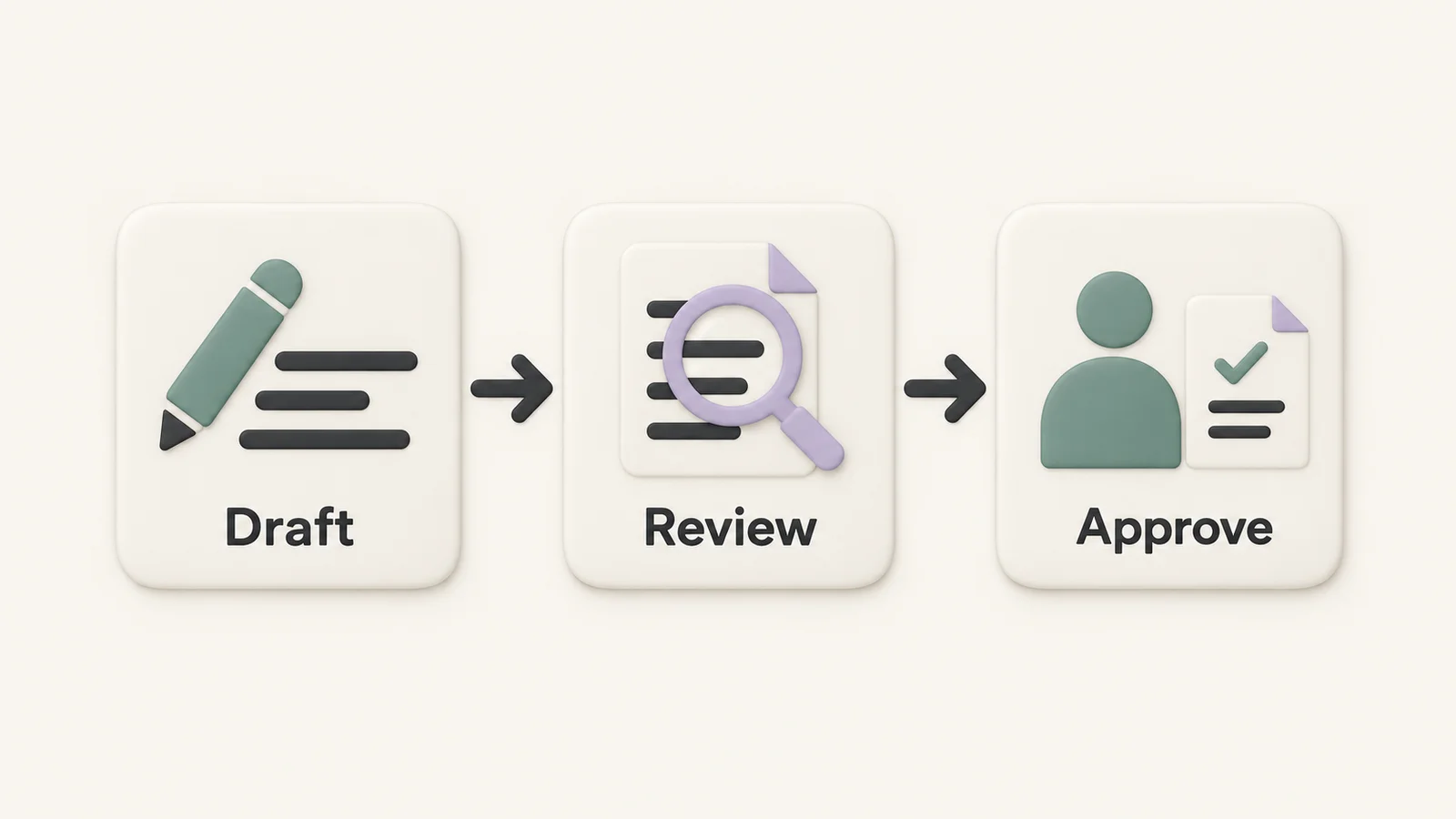
Draft with current context, review the output against your sources, and obtain human approval before publishing.
Conclusion: Review Every Output Before Publishing
Once you’ve saved your templates and added current context, follow this workflow before publishing: approved brand brief → saved prompt → current audience, channel, goal, and source copy → draft or revision → fact-check → brand-voice review → human approval → publish. Use the remaining prompts as needed.
Check claims, prices, dates, quotes, links, and product details. Then review accessibility and U.S. formatting. Compare the copy with your brand brief, and read it aloud to check the tone.
Use the final-check prompt to flag unsupported claims, off-brand terms, unclear wording, and accessibility issues. A human reviewer must resolve those issues before approving the copy. Saved prompts make the process repeatable - not automatically correct.
FAQs
How can I measure brand-voice consistency?
Use ChatGPT to check content against your brand guidelines. Save your audience details, tone, and prohibited claims in a reusable prompt template with a tool like StylerGPT’s Prompt Manager.
Submit the template alongside your draft, then ask ChatGPT to flag lines that don’t follow your guidelines. You can also compare the draft with past successful examples to check that its voice stands apart and meets your editorial standards.
How do I prevent voice drift across revisions?
Use the same saved voice instructions for every revision - don’t rely on previous chats. Define the audience, tone, and structure, along with prohibited assumptions or claims and rules for separating evidence from assumptions. Reinsert these instructions for every draft or fix.
Use placeholders for details that change, and fill them in before sending. Keep the voice rules unchanged. In StylerGPT, save the instructions as Prompt Manager templates and insert them into the composer each time.
Can I reuse these prompts for multiple brands?
You can reuse the same prompt templates across multiple brands. Just update the brand-specific context before sending. Use variables or bracketed placeholders for the audience, voice, constraints, and current product facts. That keeps one brand’s details from carrying over to another.
StylerGPT’s guidance and prompt templates are instructions you choose to send - not rules automatically enforced across conversations.
Sources
Official references used to support the product details and factual claims in this article.